BEST VIEWED IN LANDSCAPE MODE ON MOBILE DEVICES
U.S.FTC GUIDELINES PLEASE NOTE: we act as an affiliate for several companies that feature on our website. In some cases we may earn a commission from referrals to those companies. For further information please refer to our Privacy and Disclaimer policies which can be found in the "US" tab.
U.S.FTC GUIDELINES PLEASE NOTE: we act as an affiliate for several companies that feature on our website. In some cases we may earn a commission from referrals to those companies. For further information please refer to our Privacy and Disclaimer policies which can be found in the "US" tab.
The New Zealand Maori people are the
indigenous people of Aotearoa (New Zealand) and first arrived over 1000
years ago, travelling from their ancestral homeland of Hawaiki in small
ocean going canoes (waka).
Today, New Zealand Maori people account for around 14% of the national
population, and their culture and language have an enormous impact on
every day life in New Zealand.
Where It All Started-The Creation Of New Zealand
According to Maori tradition, New Zealand was created by the god Maui.
Maori legend has it that Maui, while fishing, hooked up the North Island
(known as Te Ika a Maui, or the fish of Maui). Maori describe the South
Island as Maui's waka (canoe) and Stewart Island (known as Rakiura) as
Maui's punga (anchor). The New Zealand Maori believe the far north of
the North Island to be the tail of the fish, and Wellington Harbour the
mouth.
Maori Culture
The culture of the
New Zealand Maori people
is varied and unique, and is expressed in many ways, such as arts,
weaving, tattoo (moko), carving (here is a short video that talks about
greenstone carvings),
and group performances. Today, New Zealand Maori people reproduce many
of the techniques used for centuries by their ancestors (tipuna), but
also use many modern forms of expression such as film and television,
theatre, and even hip hop music.
How Do You Pronounce Those Names??
The language of the New Zealand Maori people, known as Te Reo Maori, is
actually a very structured one, and you will notice that most place
names have a New Zealand Maori origin.
The language consists of five vowel sounds: a,e,i,o,u (the "a" as in
"car", the "e" as in "egg", the "i" like the "ee" in "tee", the "o" as
in "four", and the "u" like an "o" in "to".
There are also eight consonants similar to those in English-"h", "k",
"m", "n", "p", "r", "t" and "w". In addition are two special consonants,
"wh" and "ng". The "wh" sound is pronounced like the English "f", and
the "ng" is like the "ng" in "sing". Words can also begin with "ng".
So, for example, the location Whakatane, is pronounced "fa-ca-ta-ne".
Some common New Zealand Maori words and phrases:
Kia ora-Hello
Kia ora tatou-Hello everyone
Tena koe-Greetings to you
Tena koutou-Greetings to you all
Haere Mai-Welcome
Nau mai-Welcome
Kei te pehea koe?-How's it going?
Kei te pai-Good
Tino pai-Really good
Haere ra-Farewell
Ka kite ano-Until I see you again (Bye)
Hei konei ra-See you later
To learn more about some common Maori words and phrases and to hear
them, the following link will take you to the New Zealand Government
website,
NZ History.
New Zealand Maori Protocol
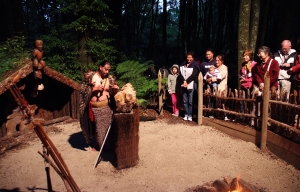
As tribal Polynesian people, New Zealand Maori have a unique protocol, best witnessed at a marae (Maori meeting place).
The formal welcome is known as a powhiri. The powhiri begins with a wero
(challenge) by a warrior from the tangata whenua (hosts), to the
manuhiri (guests). The warrior may carry a taiaha (spear), and will then
lay down a token (often a small branch) that the manuhiri will pick up
to show that they come in peace. Some kuia (women) from the hosts will
perform a karanga (call/chant) to the guests. Women from the manuhiri
will then respond as they move onto the marae in front of their men.
Once inside the wharenui (meeting house) on the marae, mihimihi
(greetings) and whaikorero (speeches) are made. Waiata (songs) may also
be sung. It is also normal for the manuhiri (guests) to present a koha
(gift) to the tangata whenua after greeting the hosts with a hongi-the
ceremonial touching of noses. After the powhiri, kai (food) may be
shared.
Click here to read your free 18 page booklet "Introduction To Maori Culture" in your browser, or right-click to download it.
Our thanks to
newzealand.com
for some of the information and photos on the New Zealand Maori people.

